 2014, Vol. 57


地震是个力学过程,研究应力变化及其深部地球介质的动力学问题,首先需要搞清浅部地壳的各向异性背景.由于各种地震波均穿透结晶基底,因此,地壳浅部结晶基底以上的各向异性问题是一个无法回避的重要问题.
研究地震各向异性的方法很多,包括P波走时差异(Oreshin et al., 2002; Martynov et al., 2004; Leykam et al., 2010)、地震面波偏振差异(Kirkwood and Crampin, 1981; Crampin and Booth, 1985; Debay and Kennet, 2000)、横波分裂(Crampin,1981; Vinnik et al., 1989;Silver and Chan, 1991;姚陈等,1992; 高原等,1995; Savage,1999; Zhang et al., 2000; Cochran et al., 2006; Snyder and Bruneton, 2007)和接收函数(Levin and Park, 1998; Savage,1998; Levin et al., 2002a; 田宝峰等,2008; 齐少华等,2009).由于远震PS转换波主要出现在速度间断面上,因此,近年来利用接收函数研究地球各向异性特征引起人们的关注.
远震PS波分裂在不同记录频带范围内有不同显示.在一些宽频带远震记录上的初始部分仅可分辨出远震直达P波和来自Moho面的PS波,此时 PS波分裂可作为对地壳整体各向异性的响应.近些年来,利用接收函数研究地壳内部的各向异性取得了很大进展(McNamara and Owens, 1993; Vinnik and Montagner, 1996; Peng and Humphreys, 1997; Levin and Park, 1997; Savage,1998; Frederiksen and Bostock, 2000; Frederiksen et al., 2003; Levin et al., 2002b; Ozacar et al., 2004; Sherrington et al., 2004; 徐震等,2006; Savage et al., 2007; Levin et al., 2008; Obrebski and Castro, 2008; 房立华和吴建平,2009),表明用PS波探测地壳各向异性具有巨大的潜力.
然而,基于Moho面PS波的接收函数研究尚不能完全满足实际观测记录解释的需要.例如,在径向和切向两分量上的研究对于进一步的解释还存在困难;没有考虑P波偏振的影响,对于P波入射角较大的远震记录则无法做进一步的PS波分裂特征研究,缩小了资料的利用范围.并且,由于Moho面PS波经常受到来自地壳的多次波及其它干扰波的影响,为了提高信噪比,突出各向异性或倾斜界面的影响,所采用的加权叠加方法模糊了介质的各向异性信息,对于进一步获取各向异性参数会非常困难.同时,上述研究也没有涉及浅部地壳的各向异性问题.
首都圈地区以其特殊的地质构造背景颇受地学工作者的关注,近些年来取得了一系列地质和地球物理成果,例如获得了首都圈地区地壳和上地幔速度结构(Huang and Zhao, 2004; 王夫运等,2005;黄金莉和赵大鹏,2005;齐诚等,2006;刘启元等,2007;胡中民等, 2008a,2008b; 王峻等,2009a;沈伟森等,2010; 杨峰等,2010),地壳厚度和泊松比(王峻等,2009b),各向异性横波分裂和应力特征(赖院根等,2006;吴晶等, 2007,2008;常利军等,2008;高原等,2010; Gao et al., 2011),活动断裂特征与强震关系(徐锡伟等,2002;高战武等,2010)等.该地区结晶基底,即新生代、中生代和古生代沉积建造的底界(刘保金等,2009;滕吉文等,2010)不同地区埋深不同,之上沉积盖层厚度变化大(嘉世旭等,2006;罗艳等,2008;贺传松等,2010),从隆起区的1~2 km,到拗陷区的3~7 km;对于基底以上各向异性背景强弱的估计势必具有重要意义.
我们注意到,首都圈地区数字化地震台网积累了大量高精度地震资料,其中,短周期台站的远震记录中P波和PS波的视周期在1s左右,在记录上可以分辨来自结晶基底的PS转换波.同时,已有的实际观测研究也证实该PS震相相对清楚、稳定,有相当的振幅,横向上埋深有所变化,是地壳内除Moho面PS震相外另一稳定的转换震相(邵学钟等, 1980,1989;贺传松等,2010).因此,本文将利用来自结晶基底的PS震相干扰小、信噪比高的特点,进行远震基底PS波分裂研究,探讨首都圈地区浅部地壳的各向异性背景. 2 数据和方法 2.1 数据
首都圈数字地震台网始建于1999年.该台网共有107个台站,观测系统的动态范围优于130 dB.其中59个台站为短周期地震仪(如图 1所示),大部分位于台网南部和东南部为第四纪所覆盖的地区,观测频带为1~20 Hz;其余48个台站为宽频带地震仪,大多为设在太行隆起与燕山隆起的地面台站.该台网东西跨度约500 km,南北跨度约400 km,平均台间距为40 km(庄灿涛,1999).
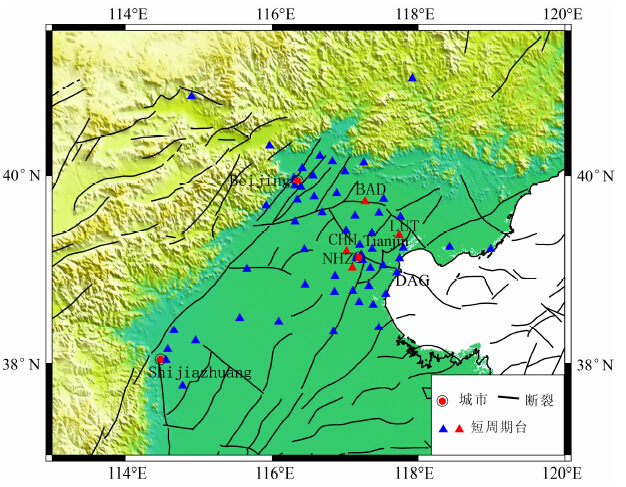 | 图 1 首都圈台网短周期台站位置图 Fig. 1 Map showing locations of short-period stations of Capital Area Seismic Network(CASN) |
本研究根据中国地震台网地震目录报告提供的地震定位参数,收集并整理了首都圈台网短周期台站2002年5月至2003年11月的地震数据,共28,792个地震记录.针对首都圈地区的浅部地壳各向异性进行探讨,主要分析该地区短周期台站来自结晶基底的PS波分裂特征.研究中所用的远震震级M≥5.0级,其震中距范围为10°~90°. 2.2 方法
尽管来自结晶基底的远震PS转换波的干扰较少,但浅部地壳的影响因素也很多,仍需要特殊的处理技术.例如,快慢波的振幅比变化、弱震相的检测等等存在很多困难.为此,本文采用基于垂向、径向和切向三个分量统一处理的PS波分裂偏振分析方法(郝重涛和姚陈,2012),实质是通过旋转坐标系的方法来保持原始波场信息和获取分裂参数.三分量远震资料包含着丰富的运动学和动力学信息,该PS波分裂偏振分析方法的具体步骤如下:
(1)数据前处理:如图 2a所示,选择原始三分量记录中相对高频的P波,即挑选初至的P波为大头波,避开源区和接收区P波后续波列的影响,从而减少对基底PS波的干扰.
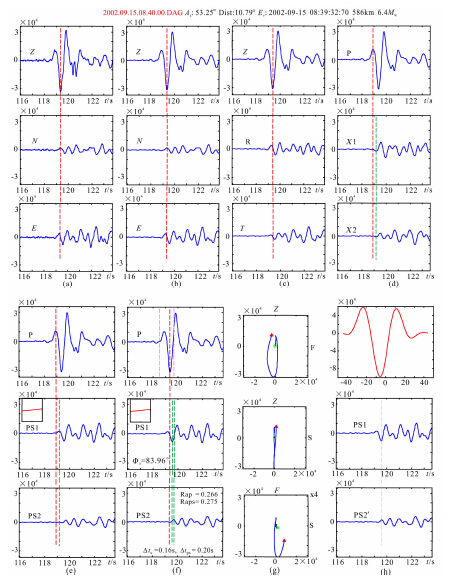 | 图 2 三分量PS波分裂偏振分析 (a)数据前处理(原始三分量记录);(b)数据预处理(基准校正、去偏斜校正和滤波分析处理);(c)PS波分裂检测;(d)P波偏振分析;(e)PS 波偏振分析;(f)参数提取校验;(g)质点运动图;(h)相关时移放大;最上方红色数字为台站事件编号,黑色数字分别为方位角(Az)、震中距(Dist)和远震事件(Ev)的发震时间、震源深度和震级;红色和绿色长虚线分别显示了三分量波形峰谷点的相互对应关系;(e)(f)图中红色短实线和Φs表示快波偏振方向,Δts为快慢波延时,Δtps为P与PS1快波时差,Rap为PS波与P波振幅比,Raps为慢波与 快波振幅比,粉色长虚线间隔为质点运动图的时窗范围. Fig. 2 Polarization analysis of three-component PS-wave splitting |
(2)数据预处理:如图 2b所示,包括原始三分量记录的基准校正、去偏斜校正和滤波分析处理.根据三分量地震数据中各种噪音、有效信号及其空间、频率、速度等特征,对比分析不同分量上噪音特征的共性与差异;针对不同物理性质差异的噪音设计滤波器;进行滤波试验,选择滤波处理,剔除较低频和较高频噪声而不破坏用于分析的基底PS波信息.
(3)PS波分裂检测:将原始三分量Z(垂直)、N(南北)和E(东西)记录按照震源方位角旋转为Z(垂直)、R(径向)和T(切向)分量,分析R和T分量记录特征,检测是否记录到PS波分裂现象.如图 2c所示,我们发现在切向分量上同样记录到了PS转换波,且PS转换波在径向分量和切向分量上具有同等的振幅水平,但到时、波形特征不完全相同,这是PS波分裂的显著特征.
(4)P波偏振分析:如图 2d所示,获取P波偏振方向,将原始三分量记录旋转到P波偏振方向、X1和X2分量上,从而去除P波在X1和X2分量上的投影;这里,X1和X2分量垂直于P波偏振方向,是P波零偏振面内的PS波,也是快慢波相互干涉的结果,区别于通过旋转震源方位角而得到的R和T分量.
(5)PS波偏振分析:如图 2e所示,在P波的零偏振面内对X1和X2分量再进一步旋转,得到两个偏振方向相互正交的PS1快波和PS2慢波.
(6)参数提取校验:对原始数据恢复进行第二次处理,不同之处是在(2)和(3)的基础上选择先旋转再滤波的处理分析以保持原始波形的一致性,同时结合质点运动图分析(图 2g)和相关时移放大分析(图 2h)进行相关检验与校正,最终提取PS波分裂参数(图 2f),包括快波偏振方向、快慢波时差和振幅比测量等.
众所周知,旋转并不改变原始波场信息.这里的三分量PS波分裂偏振分析方法突出的特点是保持了原始波场的信息,并且是在P波零偏振面内进行PS波偏振分析;针对实际地震资料,形成一套正确有效的PS波分裂参数检测技术,包括偏振、到时差、快慢波振幅比以及与P波的振幅比等信息. 3 结果分析
作为例子,本文分别挑选了位于台网中东部第四纪覆盖区的宝坻(BAD),南河镇(NHZ),长虹公园(CHH)和芦台(LUT)共4个台站(如图 1中红色三角位置所示)的2个远震事件的地震记录来分析研究.这4个台站位于盆地的不同构造区域,其中BAD台位于渤海湾盆地沧县隆起的北部,NHZ和CHH台位于渤海湾盆地沧县隆起的中部,LUT台位于渤海湾盆地黄骅坳陷的东北边缘.这些地震记录均满足初至的P波为大头波特征的条件.针对本文所选取的短周期记录,在基准校正和去偏斜校正之后,选择了1~3 Hz的Butterworth带通滤波处理.如下图 3—图 6分别给出各台站2个远震事件的具体结果:各图中最上方红色数字为台站事件编号,黑色数字分别为方位角(Az)、震中距(Dist)和远震事件(Ev)的发震时间、震源深度和震级;(a)、(c)为原始三分量地震记录,从上到下依次为Z、N和E三个分量;(b)、(d)为三分量PS波分裂偏振分析结果,从上到下依次为P、PS1和PS2的三个分量;图中红色和绿色长虚线分别显示了三分量波形峰谷点的相互对应关系,红色短实线和Φs表示PS1快波的偏振方向,Δts为PS2慢波相对于PS1快波的延时,Δtps为PS1快波与P波的时差,Rap为PS波与 P波的振幅比,Raps为PS2慢波与PS1快波的振幅比.
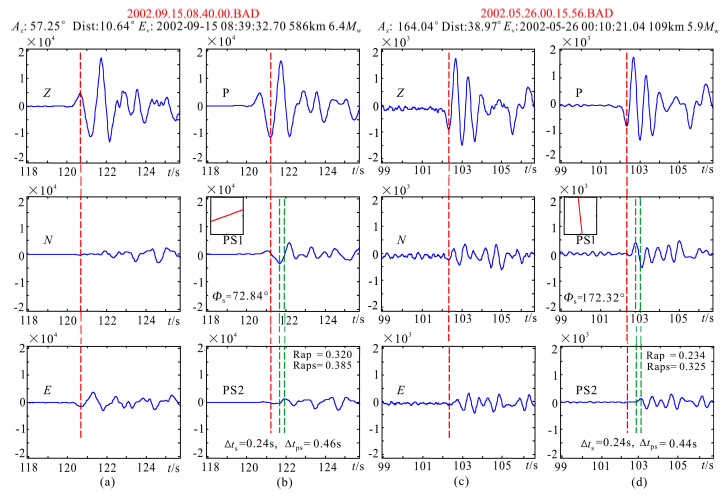 | 图 3 BAD台2个远震事件三分量PS波分裂偏振分析结果 Fig. 3 Results of polarization analysis of three-component PS-wave splitting for two tele-seismic events at BAD station |
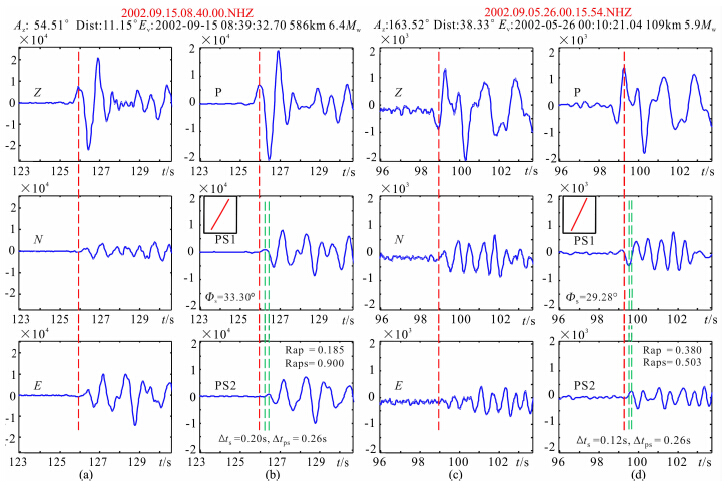 | 图 4 NHZ台2个远震事件三分量PS波偏振分析结果 Fig. 4 Results of polarization analysis of three-component PS-wave splitting for two tele-seismic events at NHZ station |
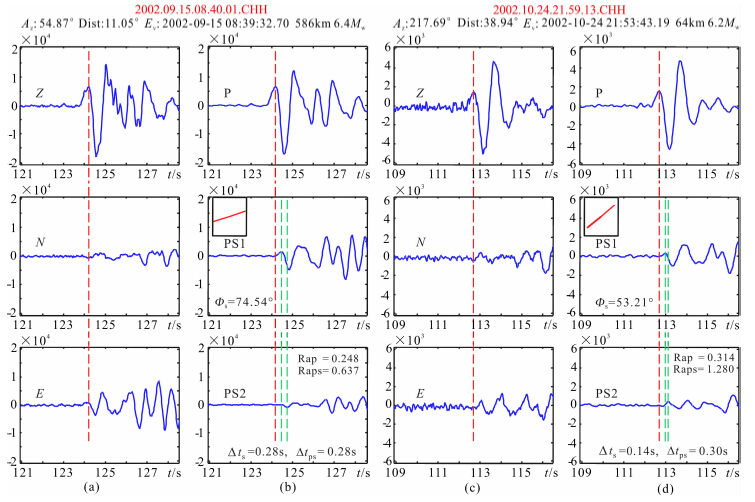 | 图 5 CHH台2个远震事件三分量PS波偏振分析结果 Fig. 5 Results of polarization analysis of the three-component PS-wave splitting for two tele-seismic events at CHH station |
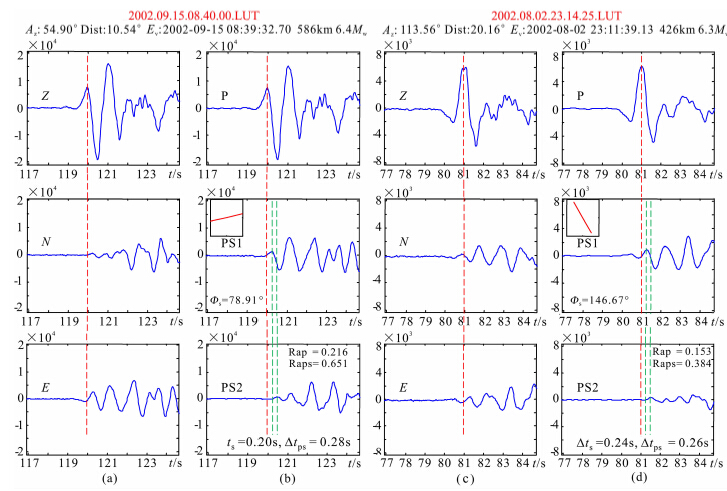 | 图 6 LUT台2个远震事件三分量PS波偏振分析结果 Fig. 6 Results of polarization analysis of three-component PS-wave splitting for two tele-seismic events at LUT station |
如图 3所示,给出了BAD台站记录的编号2002.09.15.08.40.00和2002.05.26.00.15.56的2个远震事件的分析结果,前者的方位角和震中距分别为57.25°和10.64°,后者的方位角和震中距分别为164.04°和38.97°.图 3中2个远震记录均具有清晰的分裂特征:快慢波时差均为0.24 s,P波与PS1波时差分别为0.46 s和0.44 s,较为一致;PS1快波偏振方向分别为72.84°和172.32°,相差较大,可以与文献(高原和吴晶,2008)中横波分裂得到的BAD台的快剪切波偏振方向94.69°±31.45°的结果相对比;PS波振幅与P波的综合振幅比分别为0.320和0.234,PS2慢波振幅与PS1快波的振幅比分别为0.385和0.325,均显示了较强的振幅比.
图 4则给出了NHZ台站记录的编号2002.09.15.08.40.00和2002.05.26.00.15.54的2个远震事件的分析结果,与BAD台所选择的2个远震相 同,前者的方位角和震中距分别为54.51°和11.15°,后者的方位角和震中距分别为163.52°和38.33°.其分裂结果是:快慢波时差分别为0.20 s和0.12 s,平均为0.16 s;P波与PS1波时差均为0.26 s;PS1波偏振方向分别为33.30°和29.28°,二者相差较小,而文献(高原和吴晶,2008)中横波分裂得到的 NHZ台的快剪切波偏振方向结果是47.50°±43.95°; PS波振幅与P波的振幅比分别为0.185和0.380,PS2波振幅与PS1波的振幅比分别为0.900和0.503,显示了慢波与快波有相当的振幅.
图 5给出了CHH台站记录的编号2002.09.15.08.40.01和2002.10.04.21.59.13的2个远震事件PS波偏振分析结果,其中前者与BAD和NHZ 台站为同一远震事件,方位角和震中距分别为54.87°和11.05°;后者的方位角和震中距分别为217.69°和38.94°.其分裂结果是:快慢波时差分别为0.28 s和0.14 s,平均为0.21 s;P波与PS1波时差分别为0.28 s和0.30 s;PS1波偏振方向分别为74.54°和53.21°,相差近20°,而文献(高原和吴晶,2008)中横波分裂得到的CHH台的快剪切波偏振方向为96.67°±9.43°; PS波振幅与P波的振幅比分别为0.248和0.314,PS2波振幅与PS1波的振幅比分别为0.637和1.280,显示了慢波与快波的振幅相当,表明沉积层对转换横波的振幅具有放大作用,与前人研究结果(刘启元和邵学钟,1985)一致.
图 6给出了LUT台站记录的编号2002.09.15.08.40.00和2002.08.02.23.14.25的2个远震事件PS波偏振分析结果,同样前者与BAD、NHZ和CHH台站为同一远震事件,方位角和震中距分别为54.90°和10.54°;后者的方位角和震中距分别为113.56°和20.16°.其分裂结果是:快慢波时差分别为0.20 s和0.24 s,平均为0.22 s;P波与PS1波时差分别为0.28 s和0.26 s;PS1波偏振方向分别为 78.91°和146.67°,而文献(高原和吴晶,2008)中横 波分裂得到的LUT台的快剪切波偏振方向为124.77°±27.41°; PS波振幅与P波的振幅比分别为0.216和0.153,PS2波振幅与PS1波的振幅比分别为0.651和0.384.
综合对比各图结果,将各台站PS波分裂结果列于如下表 1,表中各参数的含义与图 3—图 6相同,同时还包括了相应的远震事件方位角(Az)、震中距(Dist)、震源深度(Dp)和震级(M).由于本文所选择的4个台站分别位于不同构造区域,研究发现 同一远震不同台站的分裂参数不同,尽管同一远震不同台站的波形记录特征一致;而不同远震同一台站的分裂参数却具有一定的稳定性.

|
表 1 首都圈台网东南部地区4个台站PS波偏振分析结果 Table 1 Analysis results of PS-wave splitting for 4 stations southeast of CASN |
值得强调的是,在数据的处理分析过程中确信分析的震相是来自基底的PS转换波,同时确信PS波分裂现象的存在尤其重要.在前人研究工作的基础上,本文从走时和振幅两个方面来确定震相:首先观测P和PS这两个震相的时差,如果是PPPS的话,走时上多了两个P波路径,时差则会多出2 s左右,而实际记录显示来自基底的P和PS时差在1 s以内;其次,透射转换与反射转换的反射系数相当,如果多了2个P波反透射路径则PS震相的能量会更弱,但实际记录中并非如此.此外,通过将原始三分量记录按震源方位角旋转为垂向、径向和切向分量,分析切向分量特征来确定PS波分裂的存在.
对于水平层状各向同性介质,P波在界面上只激发P-SV波,不激发P-SH波,切向分量记录不到PS转换波.因此,各向同性传播理论不能解释上述三分量记录特征.对于大角度倾斜界面,P波在界面上激发P-SV波会具有切向分量,当介质为各向同性时,两水平分量上的PS转换波的到时、波形均相同,只是两水平分量上振幅关系依赖于远震方位(陈九辉和刘启元,2000).但是,实际记录径向分量和切向分量上PS转换波的到时、波形均不同.用各向同性倾斜界面解释不了上述PS波的PS1和PS2分量具有不同的偏振和到时特征.
同时,远震理论地震图研究结果表明,当地壳存在各向异性时,PS波分裂成PS1波和PS2波,这两个波的偏振和到时差与各向异性对称性和远震方位有关(姚陈,1989).地壳各向异性引起的PS波分裂的整体特征很难用复杂地壳结构做出解释. 4 结论
本文的研究结果显示:首都圈地区远震三分量记录中来自结晶基底的PS震相清楚、稳定,具有干扰小、信噪比高的特点;在切向分量上同样记录到PS波动,且切向分量整体能量与径向分量相当,但切向分量与径向分量上波形特征和到时不同,表明PS波存在分裂.三分量PS波分裂偏振分析方法保持了原始波场信息;P波零偏振面内的偏振分析结果表明,切向分量上记录到的PS波是快慢波相互干涉的结果,是浅部地壳存在各向异性的特征.几个台站的PS波分裂结果也显示,各向异性快波偏振方向在不同区域有所不同,有些台站不同地震的偏振方向有些散,与横波分裂结果相似;各台站快慢波时差超出了我们的预期值,平均在0.1~0.2 s左右,远大于横波分裂时差.
相比横波分裂和SKS研究,本研究不失是一种研究地壳各向异性的独立探测方法,提供了获得基底以上地壳各向异性的有效途径.由于各种远震和近地震的地震波均穿透基底,此研究无论对发展远震PS波分裂技术本身,还是对近震横波分裂及其他震相各向异性观测解释,认识首都圈地区上地壳各向异性及其内部的应力状态,分析其构造及地震活动现象有意义.
致谢 本研究工作得到了中国地震局地质研究所刘启元研究员、陈九辉研究员、郭飚副研究员、王峻博士和齐少华博士的帮助,在此表示由衷的感谢,感谢两位匿名评审专家对本研究的重要评审意见及建议.| [1] | Chang L J, Wang C Y, Ding Z F. 2008. A study on SKS splitting beneath Capital area of China. Acta Seismologica Sinica (in Chinese), 30(6): 551-559. |
| [2] | Chen J H, Liu Q Y. 2000. Wavefield features of teleseismic receiver function laterally inhomogeneous media. Acta Seismologica Sinica (in Chinese), 22(6): 614-621. |
| [3] | Cochran E S, Li Y G, Vidale J E. 2006. Anisotropy in the shallow crust observed around the San Andreas Fault before and after the 2004 M6.0 Parkfield earthquake. Bull. Seismol. Soc. Am., 96(4B): S364-S375. |
| [4] | Crampin S. 1981. A review of wave motion in anisotropic and cracked elastic media. Wave Motion, 3(4): 343- 391. |
| [5] | Crampin S, Booth D C. 1985. Shear-wave polarizations near the North Anatolian Fault-II. Interpretation in terms of crack-induced anisotropy. Geophys. J. R. Astron Soc., 83(1): 75-92. |
| [6] | Debay E, Kennet B L N. 2000. Anisotropy in the Australian upper mantle from Love and Rayleigh waveform inversion. Earth and Planetary Science Letters, 184(1): 339-351. |
| [7] | Fang L H, Wu J P. 2009. Effects of dipping boundaries and anisotropic media on receiver functions. Progress in Geophys. (in Chinese), 24(1): 42-50. |
| [8] | Frederiksen A W, Bostock M G. 2000. Modeling teleseismic waves in dipping anisotropic structures. Geophys. J. Int., 141(2): 401-412. |
| [9] | Frederiksen A W, Folsom H, Zandt G. 2003. Neighbourhood inversion of teleseismic Ps conversions for anisotropy and layer dip. Geophys. J. Int., 155(1): 200-212. |
| [10] | Gao Y, Zheng S H and Sun Y. 1995. Crack-induced anisotropy in the crust from shear wave splitting observed in Tangshan region, North China. Acta Seismologica Sinica, 8(3): 351-363. |
| [11] | Gao Y, Wu J. 2008. Compressive stress field in the crust deduced from shear wave anisotropy: An example in capital area of China. Chinese Science Bulletin (in Chinese), 53(23): 2933-2939. |
| [12] | Gao Y, Wu J, Yi G X, et al. 2010. Crust-mantle coupling in North China: Preliminary analysis from seismic anisotropy. Chinese Sci. Bull., 55, doi: 10.1007/s11434-010-4135-y. |
| [13] | Gao Y, Wu J, Fukao Y S, et al. 2011. Shear wave splitting in the crust in North China: Stress, faults and tectonic implications. Geophys. J. Int., 187(2): 642-654. |
| [14] | Gao Z W, Chen Q F, Huang J L, et al. 2010. Velocity structure beneath the active faults in Beijing area and their seismo-tectonic characteristics. Technology for Earthquake Disaster Prevention (in Chinese), 5(3): 271-280. |
| [15] | Hao C T, Yao C. 2012. Polarization analysis of the tele-seismic PS converted-wave splitting from the basement. Annual of the Chinese Geophysical Society, 301. |
| [16] | He C S, Zhu L P, Ding Z F, et al. 2010. Sedimentary Cover in the Bohai Basin using teleseismic receiver function. Acta Geologica Sinica (in Chinese), 84(5): 716-722. |
| [17] | Hu Z M, Wang F Y, Liu M J, et al. 2008a. Inversion of the upper crustal velocity structure in capital area with Pg wave. North China Earthquake Sciences (in Chinese), 26(2): 1-6. |
| [18] | Hu Z M, Wang F Y, Liu M J. 2008b. A study on crustal structure of Tianjin-Beijing-Chicheng DSS profile. South China Journal of Seismology (in Chinese), 28(1): 41-51. |
| [19] | Huang J L, Zhao D P. 2004. Crustal heterogeneity and seismotectonics of the region around Beijing, China. Tectonophysics, 385: 159-180. |
| [20] | Huang J L, Zhao D P. 2005. Three dimensional P wave velocity tomography and deep structure related to strong earthquake in Capital area. Chinese Sci. Bull. (in Chinese), 50(4): 348-355. |
| [21] | Jia S Y, Qi C, Wang F Y, et a1. 2006. Three-dimension crustal gridded structure of the capital area. Chinese J. Geophys. (in Chinese), 48(6): 1316-1324. |
| [22] | Kirkwood S C, Crampin S. 1981. Surface-wave propagation in an ocean basin with an anisotropic upper mantle: Observations of Polarization anomalies. Geophys. J. Int., 64(2): 487-497. |
| [23] | Lai Y G, Liu Q Y, Chen J H, et al. 2006. Shear wave splitting and the features of the crustal stress field in the capital circle. Chinese J. Geophys. (in Chinese), 49(1): 189-196. |
| [24] | Levin V, Park J. 1997. Crustal anisotropy beneath the Ural mountains fordeep from teleseismic receiver functions. Geophys Res. Lett., 24(11): 1283-1286. |
| [25] | Levin V, Park J. 1998. P-SH conversions in layered media with hexagonally symmetric anisotropy: A cookbook. Pure Appl. Geophys., 151: 669-697. |
| [26] | Levin V, Roecker S, Graham P, et al. 2008. Seismic anisotropy indicators in western Tibet: Shear wave splittingand receiver function analysis. Tectonophysics, 462: 99-108. |
| [27] | Levin V L, Park J M, Amato A. 2002a. Anisotropic seismic structure of the lithosphere beneath the Adriatic coast of Italy constrained with mode-converted body waves. Geophys. Res. Lett., 29(22): 15-1-15-4. |
| [28] | Levin V, Park J, Brandon M, et al. 2002b. Crust and upper mantle of Kamchatka from teleseismic receiver functions. Tectonophysics, 358: 233-265. |
| [29] | Leykam D, Tkaličc' H, Reading A M. 2010. Core structure re-examined using new teleseismic data recorded in Antarctica: Evidence for, at most, weak cylindrical seismic anisotropy in the inner core. Geophys. J.Int, 180(3): 1329-1343. |
| [30] | Liu B J, Hu P, Chen Y, et a1. 2009. The crustal shallow structures and buried active fau1ts revea1ed by seismic reflection profiles in northwestern area of Being plain. Chinese J. Geophys. (in Chinese), 52(8): 2015-2025. |
| [31] | Liu Q Y, Shao X Z. 1985. Study on the dynamic characteristics of PS converted waves. Chinese J. Geophys. (in Chinese), 28(3): 291-302. |
| [32] | Liu Q Y, Wang J, Chen J H, et a1. 2007. Seismogenic tectonic environment of 1976 great Tangshan earthquake: Results given by dense seismic array observations. Earth Science Frontier (in Chinese), 14(6): 205-213. |
| [33] | Luo Y, Chong J J, Ni S D, et al. 2008. Moho depth and sedimentary thickness in Capital region. Chinese J. Geophys. (in Chinese), 51(4): 1135-1145. |
| [34] | Martynov V G, Vernon F L, Kilb D L, et al. 2004. Directional variations in travel-time residuals of teleseismic P waves in the crust and mantle beneath northern Tien San. Bull Seism Soc Am., 94(2): 650-664. |
| [35] | McNamara D E, Owens T J. 1993. Azimuthal shear wave velocity anisotropy in the Basin and Range Province using Moho Ps converted phases. J. Geophys. Res., 98 (B7): 12003-12017. |
| [36] | Obrebski M, Castro R. 2008. Seismic anisotropy in northern and central Gulf of California region, Mexico, from teleseismic receiver functions and new evidence of possible plate capture. J. Geophys. Res., 113, B03301, doi: 10.1029/2007JB005156. |
| [37] | Oreshin S, Vinnik L, Makeyeva L, et al. 2002. Combined analysis of SKS splitting and regional P traveltimes in Siberia. Geophys. J. Int., 151(2): 393-402. |
| [38] | Ozacar A A, Zandt G. 2004. Crustal seismic anisotropy in central Tibet: Implications for deformational style and flow in the crust. Geophys. Res. Lett., 31(23): L23601. |
| [39] | Peng X, Humphreys E D. 1997. Moho dip and crustal anisotropy in northwestern Nevada from teleseismic receiver functions. Bulletin of the Seismological Society of America, 87(3): 745-754. |
| [40] | Qi C, Zhao D P, Chen Y, et al. 2006. 3-D P and S wave velocity structures and their relationship to strong earthquakes in the Chinese capital region. Chinese J. Geophys. (in Chinese), 49(3): 805-815. |
| [41] | Qi S H, Liu Q Y, Chen J H, et al. 2009. Wenchuan earthquake Ms8.0: Preliminary study of crustal anisotropy on both sides of the Longmenshan faults. Seismology and Geology (in Chinese), 31(3): 377-388. |
| [42] | Savage M K. 1999. Seismic anisotropy and mantle deformation: What have we learned from shear wave splitting? Rev Geophys., 37(1): 65-106. |
| [43] | Savage M K. 1998. Lower crustal anisotropy of dipping boundaries: Effects on receiver functions and a case study in New Zealand. J. Geophys. Res., 103(B7): 15069-15087 |
| [44] | Savage M K, Park J, Todd H. 2007. Velocity and anisotropy structure at the Hikurangi subduction margin, New Zealand from receiver functions. Geophys. J. Int., 168(3): 1034-1050. |
| [45] | Shao X Z, Zhang J R, Chen X H, et al. 1980. The results of deep sounding by using converted seismic waves of earthquakes in the Beijing-Tianjin-Tangshan Region. Seismology and Geology (in Chinese), 2(2): 11-20. |
| [46] | Shao X Z, Zheng B H, Zhang J R. 1989. New study results on crust structure, crust movement and conditions for earthquake preparation in Yanshan region by converted waves. Seismology and Geology (in Chinese), 11(1): 65-76. |
| [47] | Shen W S, Luo Y, Ni S D, et al. 2010. Resolving near surface S velocity structure in natural earthquake frequency band: A case study in Beijing region. Acta Seismologica Sinica (in Chinese), 32(2): 137-146. |
| [48] | Sherrington H F, Zandt G, Frederiksen A. 2004. Crustal fabric in the Tibetan Plateau based on waveform inversions for seismic anisotropy parameters. J. Geophys. Res., 109(B2): B02312. |
| [49] | Silver P G, Chan W W. 1991. Shear wave splitting and subcontinental mantle deformation. J. Geophys. Res., 96(B10): 16429-16454. |
| [50] | Snyder D, Bruneton M. 2007. Seismic anisotropy of the Slave craton, NW Canada, from joint interpretation of SKS and Rayleigh waves. Geophys. J. Int., 169(1): 170-188. |
| [51] | Teng J W, Ruan X M, Zhang Y Q. 2010. Geophysical exploration for oil and gas in the second deep space (5000-10000 m)in crust: The only way for the development of fossil energy. Progress in Geophys. (in Chinese), 25(2): 359-375,doi:10.3969/j.issn.1004-2903.2010.02.001. |
| [52] | Tian B F, Li J, Yao Z X. 2008. Study on crust anisotropy of Taihang Mountain Range by analyzing azimuthal variation of receiver functions. Acta Seismologica Sinica (in Chinese), 30(4): 355-366. |
| [53] | Vinnik L P, Farra V, Romanowicz B. 1989. Azimuthal anisotropy in the earth from observations of SKS at Geoscope and NARS broadband stations. Bull. Seism. Soc. Amer., 79(5): 1542-1558. |
| [54] | Vinnik L P.,Montagner J P. 1996. Shear wave splitting in the mantle Ps phases. Geophys Res Lett, 23(18): 2449-2452. |
| [55] | Wang F Y, Zhang X K, Chen Q F, et al. 2005. Fine tomographic inversion of the upper crust 3-D structure around Beijing. Chinese J. Geophys. (in Chinese), 48(2): 359-366. |
| [56] | Wang J, Liu Q Y, Chen J H, et a1. 2009a. Three-dimensional S-wave velocity structure of the crust and upper mantle beneath the capital circle region from receiver function inversion. Chinese J. Geophys. (in Chinese), 52(10): 2472-2482. |
| [57] | Wang J, Liu Q Y, Chen J H, et al. 2009b. The crustal thickness and Poisson's ratio beneath the capital circle region. Chinese Journal of Geophysics (in Chinese), 52(1): 57-66. |
| [58] | Wu J, Gao Y, Chen Y T, et al. 2007. Seismic anisotropy in the crust in northwestern capital area of China. Chinese J. Geophys. (in Chinese), 50(1): 209-220. |
| [59] | Wu J, Gao Y, Chen Y T. 2008. Crustal seismic anisotropy in southeastern Capital area, China. Acta Seismologica Sinica ( in Chinese), 30(1): 1-11. |
| [60] | Xu X W, W u W M, Zhang X K, et a1. 2002. The Newest Tectonics and Earthquake in Capital Area (in Chinese). Beijing: Science Press. |
| [61] | Xu Z, Xu M J, Wang L S, et al. 2006. A study on crustal anisotropy using P to S converted phase of the receiver function: Application to Ailaoshan-Red River fault zone. Chinese J. Geophys. (in Chinese), 49(2): 438-448. |
| [62] | Yang F, Huang J L, Yang T. 2010. Upper mantle structure beneath the Chinese capital region from teleseismic finite-frequency tomography. Chinese J. Geophys. (in Chinese), 53(8): 1806-1816,doi:10.3969/j.issn.0001-5733.2010.08.006. |
| [63] | Yao C. 1989. The splitting of the teleseismic PS waves propagating through cracked solids. Earthquake Research in China (in Chinese), 5(1): 38-47. |
| [64] | Yao C, Wang P D, Chen Y T. 1992. Shear-wave polarization and rack induced anisotropy of upper crust in Lulong, north China. Chinese J. Geophys. (in Chinese), 35(3): 305-315. |
| [65] | Zhang Z J, Li Y K, Lu D Y, et a1. 2000. Velocity and anisotropy structure of the crust in the Dabieshan orogenic belt from wide-angle seismic data. Phys. Earth. Planet. Inter., 122(1-2): 115-131. |
| [66] | Zhuang C T. 1999. Technical composition of the digital telemetry seismic network in capital zone. Seismological and Geomagnetic Observation and Research (in Chinese), 20(5): 23-28. |
| [67] | 常利军, 王椿镛, 丁志峰. 2008. 首都圈地区SKS波分裂研究. 地震学报, 30(6): 551-559. |
| [68] | 陈九辉, 刘启元. 2000. 横向非均匀介质远震体波接收函数的波场特征. 地震学报, 22(6): 614-621. |
| [69] | 房立华, 吴建平. 2009. 倾斜界面和各向异性介质对接收函数的影响. 地球物理学进展, 24(1): 42-50. |
| [70] | 高原, 郑斯华, 孙勇. 1995. 唐山地区地壳裂隙各向异性. 地震学报, 17(3): 283-293. |
| [71] | 高原, 吴晶. 2008. 利用剪切波各向异性推断地壳主压应力场:以首都圈地区为例. 科学通报, 53(23): 2933-2939. |
| [72] | 高原, 吴晶, 易桂喜等. 2010. 从壳幔地震各向异性初探华北地区壳幔耦合关系. 科学通报, 55(29): 2837-2843. |
| [73] | 高战武, 陈棋福, 黄金莉等. 2010. 北京地区主要活动断裂深部速度结构特征及强震构造分析. 震灾防御技术, 5(3): 271-280. |
| [74] | 郝重涛, 姚陈. 2012. 远震基底PS波分裂偏振分析. 中国地球物理年刊, 301. 贺传松, 朱露培, 丁志峰等. 2010. 用远震接收函数研究渤海盆地的沉积覆盖. 地质学报, 84(5): 716-722. |
| [75] | 胡中民, 王夫运, 刘明军等. 2008a. 用Pg波走时反演首都圈地区的上地壳速度结构. 华北地震科学, 26(2): 1-6. |
| [76] | 胡中民, 王夫运, 刘明军. 2008b. 用DSS资料研究首都圈地区的地壳结构. 华南地震, 28(1): 41-51. |
| [77] | 黄金莉, 赵大鹏. 2005. 首都圈地区地壳三维P波速度细结构与强震孕育的深部构造环境. 科学通报, 50(4): 348-355. |
| [78] | 嘉世旭, 齐诚, 王夫运等. 2006. 首都圈地壳网格化三维结构. 地球物理学报, 48(6): 1316-1324. |
| [79] | 赖院根, 刘启元, 陈九辉等. 2006. 首都圈地区横波分裂与地壳应力场特征. 地球物理学报, 49(1): 189-196. |
| [80] | 刘保金, 胡平, 陈颙等. 2009. 北京平原西北部地壳浅部结构和隐伏活动断裂——由地震反射剖面揭示. 地球物理学报, 52(8): 2015-2025. |
| [81] | 刘启元, 邵学钟. 1985. 天然地震PS转换波动力学特征的初步研究. 地球物理学报, 28(3): 291-302. |
| [82] | 刘启元, 王峻, 陈九辉等. 2007. 1976年唐山大地震的孕震环境: 密集地震台阵观测得到的结果. 地学前缘, 14(6): 205-213. |
| [83] | 罗艳, 崇加军, 倪四道等. 2008. 首都圈地区莫霍面起伏及沉积层厚度. 地球物理学报, 51(4): 1135-1145. |
| [84] | 齐诚, 赵大鹏, 陈颙等. 2006. 首都圈地区地壳P波和S波三维速度结构及其与大地震的关系. 地球物理学报, 49(3): 805-815. |
| [85] | 齐少华, 刘启元, 陈九辉等. 2009. 汶川Ms8.0地震: 龙门山断裂两侧地壳各向异性的初步研究. 地震地质, 31(3): 377-388. |
| [86] | 邵学钟, 张家茹, 陈学华等. 1980. 京津唐地区地震转换波测深结果. 地震地质, 2(2): 11-20. |
| [87] | 邵学钟, 郑炳华, 张家茹. 1989. 利用转换波新成果研究燕山地区地壳构造、地壳运动和孕震条件. 地震地质, 11(1): 65-76. |
| [88] | 沈伟森, 罗艳, 倪四道等. 2010. 天然地震频率范围内首都圈地区近地表s波速度结构. 地震学报, 32(2): 137-146. |
| [89] | 滕吉文, 阮小敏, 张永谦. 2010. 地壳内部第二深度空间(5000-10000 m)石油与天然气地球物理勘探: 化石能源发展的必由之路. 地球物理学进展, 25(2): 359-375,doi:10.3969/j.issn.1004-2903.2010.02.001. |
| [90] | 田宝峰, 李娟, 姚振兴. 2008. 利用接收函数方位变化研究太行山区地壳各向异性. 地震学报, 30(4): 355-366. |
| [91] | 王夫运, 张先康, 陈棋福等. 2005. 北京地区上地壳三维细结构层析成像. 地球物理学报, 48(2): 359-366. |
| [92] | 王 峻, 刘启元, 陈九辉等. 2009a. 根据接收函数反演得到的首都圈地壳上地幔三维S波速度结构. 地球物理学报, 52(10): 2472-2482. |
| [93] | 王峻, 刘启元, 陈九辉等. 2009b. 首都圈地区的地壳厚度及泊松比. 地球物理学报, 52(1): 57-66. |
| [94] | 吴晶, 高原, 陈运泰等. 2007. 首都圈西北部地区地壳介质地震各向异性特征初步研究. 地球物理学报, 50(1): 209-220. |
| [95] | 吴晶, 高原, 陈运泰. 2008. 首都圈东南部地区地壳介质各向异性. 地震学报, 30(1): 1-11. |
| [96] | 徐锡伟, 吴卫民, 张先康等. 2002. 首都圈地区地壳最新构造变动与地震. 北京: 科学出版社. |
| [97] | 徐震, 徐鸣洁, 王良书等. 2006. 用接收函数Ps转换波研究地壳各向异性——以哀牢山—红河断裂带为例. 地球物理学报, 49(2): 438-448. |
| [98] | 杨峰, 黄金莉, 杨挺. 2010. 应用远震有限频率层析成像反演首都圈上地幔速度结构. 地球物理学报, 53(8): 1806-1816,doi:10.3969/j.issn.0001-5733.2010.08.006. |
| [99] | 姚陈. 1989. 穿透裂隙介质远震PS波的分裂. 中国地震, 5(1): 38-47. |
| [100] | 姚陈, 王培德, 陈运泰. 1992. 卢龙地区S波偏振与上地壳裂隙各向异性. 地球物理学报, 35(3): 305-315. |
| [101] | 庄灿涛. 1999. 首都圈数字地震遥测台网的技术构成. 地震地磁观测与研究, 20(5): 23-28. |